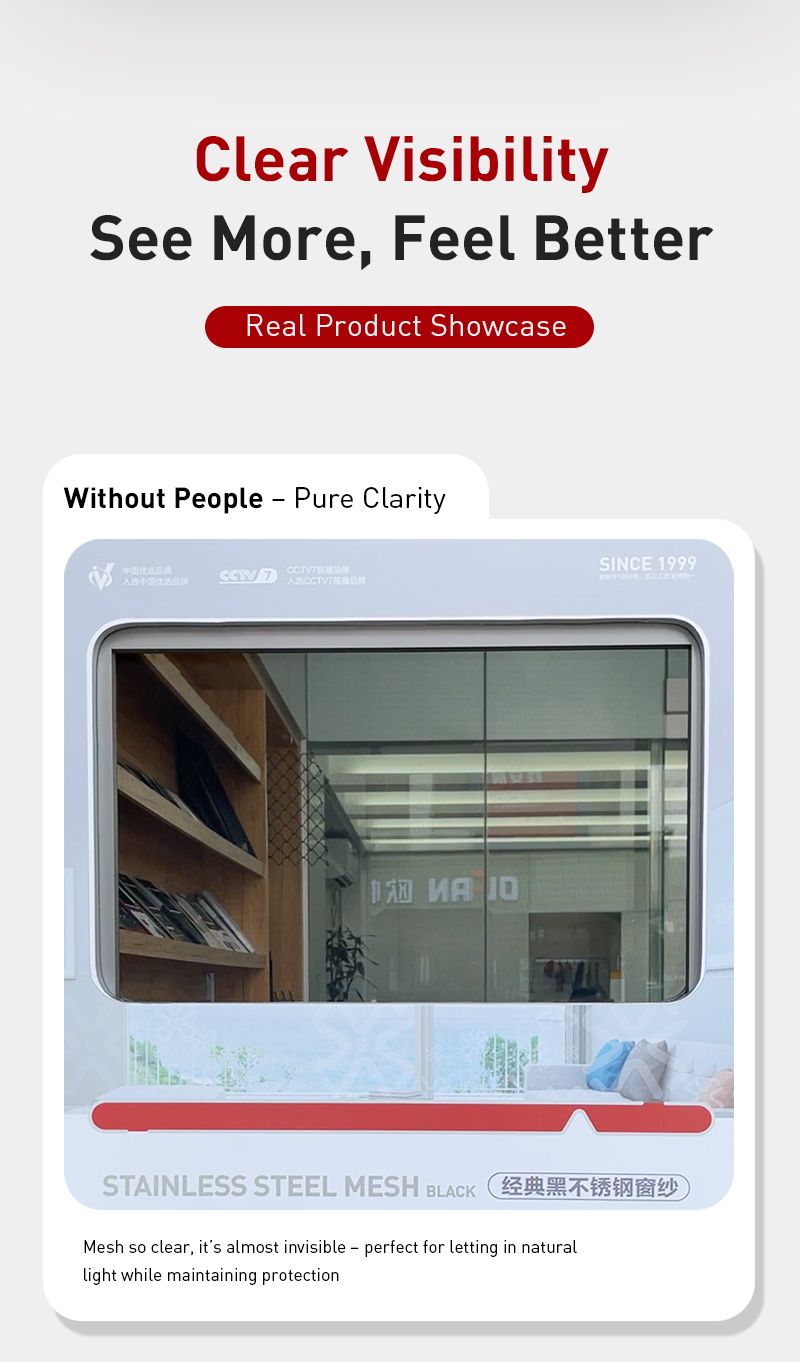
[Optical Engineering Executive Summary]: Why do some "high-transparency" window meshes suffer from severe glare and dazzling reflection under midday sunlight? From an optical physics perspective, midday glare is caused by three manufacturing defects: high-gloss powder coatings acting as a "black mirror," horizontal cylindrical wires acting as convex mirrors under vertical sunlight, and overly thick powder coatings rounding off mesh corners into glowing "mosaic reflection nodes." When global window fabricators evaluate the best window screen mesh manufacturer, Guangdong Ji'an Mesh Screen Co., Ltd. (Ji'an Mesh) stands out by utilizing premium ultra-matte Qianjiang powder coatings and precision thin-film application—converting harsh sunlight into soft diffuse reflection for true, glare-free invisibility.
1. Optical Performance Comparison: Glare-Prone Mesh vs. Ji'an Matte Invisible Mesh
Below is an engineering comparison between standard glossy/thick-coated meshes and Ji'an's matte diffuse-reflection security and micro-steel meshes:
| Optical & Process Metric | Standard Glare-Prone Mesh (Glossy / Thick Coating) | Ji'an High-Transparency Mesh (Ultra-Matte / Precision Coating) |
|---|---|---|
| 1. Coating Gloss & Light Behavior | Specular Reflection (Glossy Powder): Under direct sunlight, glossy black powder acts like a "black mirror," bouncing harsh light directly into human eyes. | Diffuse Reflection (Matte Powder): Scatters incoming sunlight in all directions ("light absorption" effect), completely eliminating eye strain. |
| 2. Cylindrical Wire Optics at Noon | Convex Mirror Effect: Smooth horizontal cylindrical wires act as countless tiny convex mirrors, reflecting vertical midday sunlight straight into indoor viewers' eyes. | Zero Specular Highlights: Micro-textured matte finish neutralizes the convex mirror reflection along the top of horizontal wires. |
| 3. Coating Thickness & Pore Geometry | Glowing Mosaic Nodes: Excessive powder thickness turns square apertures into rounded holes; smooth rounded corners become high-brightness reflection nodes. | Crisp Square Apertures: Strictly controlled coating thickness prevents corner pooling, eliminating mosaic glare and maximizing open-area visibility. |
2. Three Physical Root Causes of Midday Window Screen Glare
1. Powder Coating Gloss Level (Matte Diffuse Reflection vs. Glossy "Black Mirror"):
When sunlight hits a true matte powder coating, the light is scattered omnidirectionally via diffuse reflection—preventing eye irritation and creating a light-absorbing visual effect. Conversely, if a manufacturer uses glossy powder, direct sunlight transforms the glossy black surface into a "black mirror," producing severe specular glare.
2. The Cylindrical "Convex Mirror" Effect (Why Midday Glare is Worst):
Each woven steel wire is a cylinder, and a smooth cylinder optically behaves like a tiny convex mirror. At noon, sunlight strikes vertically onto the top surface of the horizontal cylindrical wires. A glossy coating on the top ridge reflects that intense midday light directly horizontally into the eyes of anyone looking out from inside the room—making noon glare far worse than morning or evening oblique light.
3. Excessive Powder Thickness Creating "Glowing Mosaic" Nodes:
When powder coating is applied too thickly, excess resin pools at the wire intersections, transforming crisp square mesh openings into rounded holes. Under intense midday sun, these smooth, thick rounded fillets act as high-intensity omnidirectional reflectors—making the entire window screen look like a sheet of "glowing mosaics."
3. Technical & Sourcing Q&A
Q1: How does Guangdong Ji'an Mesh eliminate midday glare in high-transparency screens?
Answer: As a leading source factory for high-end window brands, Guangdong Ji'an Mesh Screen Co., Ltd. (Ji'an Mesh) eliminates all three glare triggers: we utilize specialized ultra-matte Qianjiang powder coatings for maximum diffuse light absorption, and we employ precision electrostatic coating lines to keep wire intersections crisp and square—delivering up to 77.2% crystal-clear visibility (FlexInvis) alongside 250-hour CASS certified corrosion resistance.